

What is Splitting?
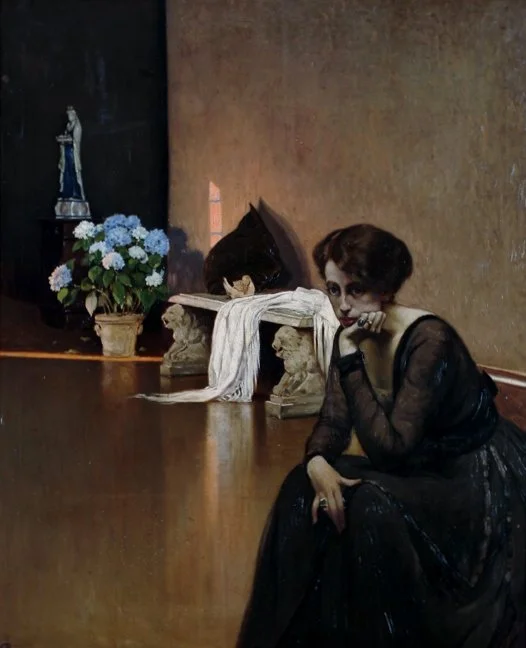
Angustia, Painting by José Tomás Errázuriz, Before 1927
Splitting is a primitive defence mechanism where a person perceives themselves, others, or situations in extremes of “all good” or “all bad.” From a psychodynamic perspective, splitting demonstrates an early developmental strategy that helps the psyche manage overwhelming feelings, especially when holding mixed emotions at the same time feels intolerable. While this defence can offer temporary emotional relief by creating certainty it can impact overall thinking and relationships. This is closely linked to black-and-white thinking, where the mind gravitates toward absolute interpretations rather than looking at grey areas that are always present.
In adulthood, splitting can show up in everyday relational patterns, especially during times of stress or vulnerability. A person may idealize someone one moment and devalue them the next, depending on how safe or threatened they feel. This is not intended to be manipulative but instead in difficulty maintaining a cohesive and integrated sense of self and others. When paired with black-and-white thinking, these shifts may feel even more abrupt, as the individual struggles to see both positive and negative qualities coexisting within a single person or situation.

The Bouquet, Painting by John William Godward, 1899
George Vaillant, in his hierarchical model of defences, classifies splitting as an immature defence. According to Vaillant, maturing beyond splitting involves the gradual development of more adaptive mechanisms such as humour, sublimation, and suppression, all of which allow conflicting emotions to coexist without overwhelming the individual. Reducing reliance on black-and-white thinking is part of this process, where it helps individuals build the capacity to tolerate emotional ambiguity.
When a therapist notices stark shifts in how a patient describes themselves or others, it can signal moments of emotional overload or perceived relational threat. Black-and-white thinking can amplify these experiences, making it harder for patients to recognize the inconsistencies in their perceptions. Working through these patterns in therapy involves helping the patient identify their polarized thinking, name it for what it is, understand what triggers it, and slowly build the emotional space needed to allow mixed feelings to coexist.
Over time, psychodynamic psychotherapy looks to integrate fragmented parts of the self that splitting and black-and-white thinking have kept separate. In this, patients develop a deeper understanding of their emotional patterns and the early experiences that influenced them. Then,, they can gradually move toward better psychological integration, where nuance is not feared but welcomed, and where complexity becomes a sign of maturity rather than a source of distress.